


THE CATEGORY CONTROL
Keep the strategy intact when execution starts pulling it apart.
A leadership-level operating rhythm that protects category, claims, proof and strategic decisions as the company moves.
The Category Control detects drift early, tests consequential decisions and keeps downstream execution aligned with the frame leadership approved.
Companies rarely lose the strategy at the moment they approve it.
They lose it later.
- A major prospect asks for a different story.
- A new executive brings familiar language from a previous company.
- A partner simplifies the proposition.
- A campaign turns the category into a feature.
- An investor compares the company with the wrong market.
- A product release creates a claim before the evidence is ready.
Each decision can look reasonable on its own. Together, they can pull the company back into the category or comparison set it had already decided to leave.
The strategy was clear. The drift was gradual.
What drift looks like.
- the category name changes between teams;
- old comparison language returns;
- the commercial wedge becomes the whole company;
- product claims move ahead of proof;
- partners shorten the story incorrectly;
- website and sales narratives diverge;
- investor language starts governing customer language;
- new hires reopen settled decisions;
- execution assets create new strategy instead of deriving from it;
- AI systems reduce the company to the nearest familiar category.
Category drift is rarely one dramatic mistake. It is accumulated strategic leakage.
What The Category Control governs.
- Category
- Is the approved frame still doing the work it was chosen to do?
- Market frame
- Are change, problem and urgency still consistent?
- Comparison set
- Is the company being judged against the right alternatives?
- Vocabulary
- Are approved terms stable across leadership and execution?
- Claims
- Are public claims classified, sourced and approved?
- Proof
- Has new evidence changed what the company can credibly say?
- Buyer interpretation
- Are the right buyers recognising the problem and decision?
- GTM execution
- Are campaigns and market-entry choices reinforcing the architecture?
- Partners
- Are partners creating access without collapsing the category?
- Capital narrative
- Are board and investor conversations protecting the company’s value?
- Downstream assets
- Are new outputs deriving from the controlled source of truth?
The operating rhythm.
The Category Control runs as a continuous seven-step loop: observe, detect, test, decide, patch, release, learn — and learning feeds back into observation.
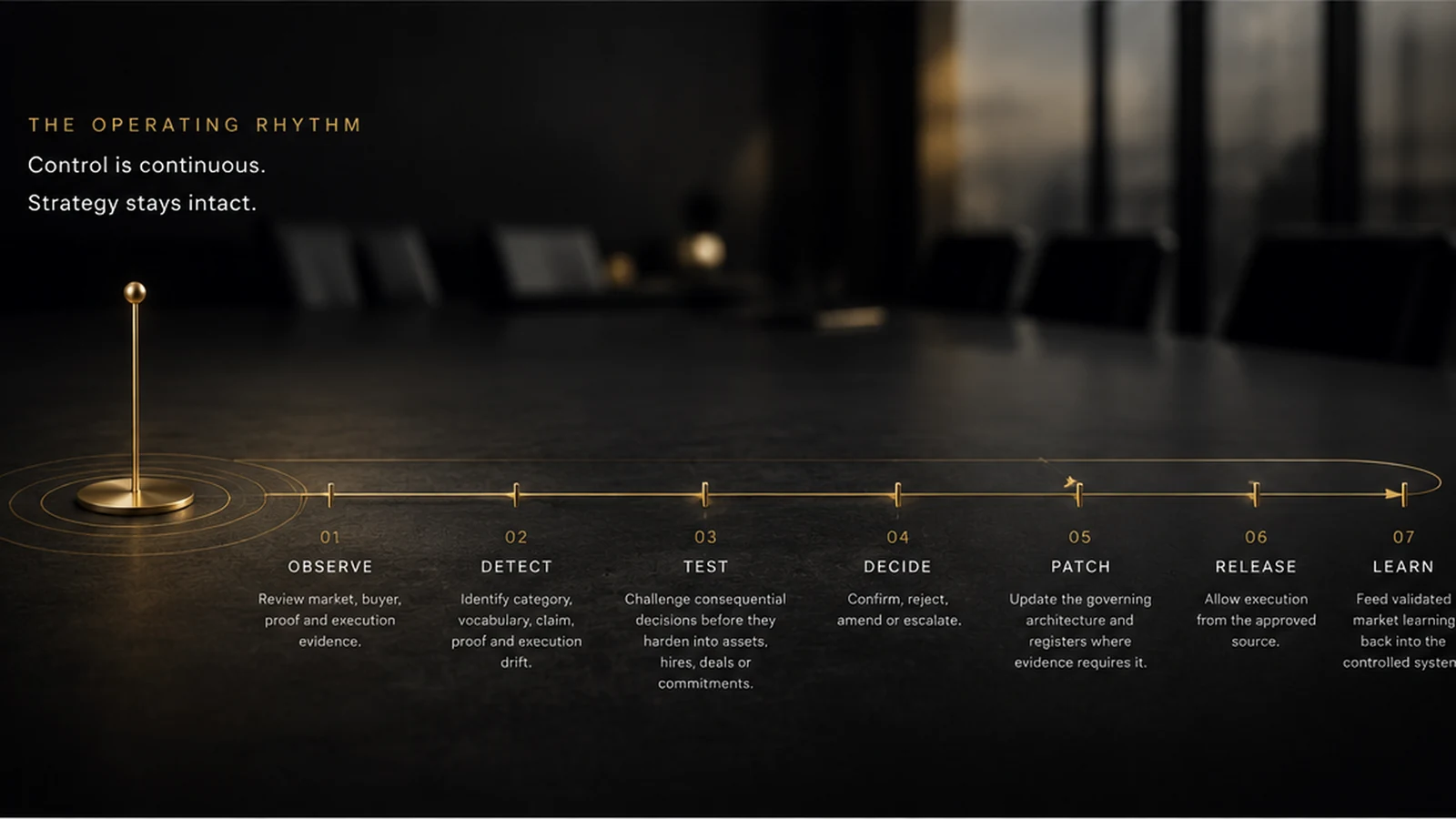
- 01ObserveReview market, buyer, proof, partner and execution evidence.
- 02DetectIdentify category, vocabulary, claim, proof and execution drift.
- 03TestChallenge consequential decisions before they harden into assets, hires, deals or commitments.
- 04DecideConfirm, reject, amend or escalate.
- 05PatchUpdate the governing architecture and registers where evidence requires it.
- 06ReleaseAllow execution from the approved source.
- 07LearnFeed validated market learning back into the controlled system.
Control does not freeze the strategy. It prevents unmanaged change.
Decisions reviewed.
The work may include:
- category or positioning changes;
- new market entry;
- major website or narrative changes;
- investor and board material;
- strategic partnerships;
- flagship opportunities;
- commercial wedge decisions;
- product and packaging changes that affect interpretation;
- new claims or quantified outcomes;
- major executive hires;
- acquisition or portfolio logic.
The Category Control does not review every operational decision. It focuses on decisions with category, capital or strategic consequence.
What leadership receives.
- periodic leadership control sessions;
- drift assessment;
- decision review;
- category and vocabulary control;
- claim and proof review;
- evidence and assumption updates;
- downstream asset review;
- market-learning synthesis;
- partner and investor translation review;
- Blueprint patches;
- decision and drift register updates;
- escalation recommendations;
- board or investor input where required.
Leadership can move quickly without allowing speed to create parallel strategy.
What The Category Control is not.
It is not:
- a fractional CRO role;
- a marketing retainer;
- campaign management;
- sales leadership;
- project management;
- approval for every asset;
- a substitute for the CEO or board;
- unlimited access to strategic advice;
- a mechanism for freezing every decision.
Venturoxx protects the strategic frame. Leadership remains accountable for execution.
When it is relevant.
Use The Category Control when:
- execution is accelerating;
- a new category or strategic frame has been approved;
- the company is entering new markets;
- multiple teams or partners are translating the strategy;
- the proof base is evolving quickly;
- investor and customer narratives must remain aligned;
- a commercial wedge could collapse into the company definition;
- high-consequence hires or partnerships are being made;
- leadership wants independent challenge before major decisions;
- the cost of drift now exceeds the cost of control.
It is usually wrong when the governing problem is still unclear. That may require The Category Risk Scan.

Control must be able to say no.
The value is the ability to challenge a decision before the company commits capital, reputation or organisational momentum to it.
That may mean rejecting a category shortcut, stopping an unsupported claim, delaying broad execution, separating the wedge from the company definition, refusing a partner translation or reopening architecture when evidence has materially changed.
Independent control is useful only when leadership is prepared to hear the answer.
The starting point is not fixed.
- Use The Category Risk Scan when the real problem is uncertain.
- Use The Blueprint when the company needs one governed decision architecture.
- Use The Category Control when the architecture exists and leadership needs to protect it through execution and change.
These are distinct engagements. They are not a mandatory ladder.
Selective by design.
The Category Control is appropriate only where the strategic architecture is sufficiently clear, decisions carry material consequence, leadership access exists and the company is willing to maintain claim, proof and vocabulary discipline.
The exact rhythm, access and scope are agreed privately.
LEADERSHIP-LEVEL CONTROL
Protect the decisions the company cannot afford to dilute.
The Category Control keeps the market frame, company strategy and capital narrative aligned while the organisation moves.